In January 2025, life felt full of momentum. My husband and I had just moved from Colorado to Tennessee to be closer to family. I was beginning my real estate career, we had just bought our first house, and we had our two precious daughters, just 2 years and 10 months old.
I was working hard to get back in shape postpartum, but something felt off. I was getting weaker, more out of breath when I ran, and I could see my muscles fading. I assumed it was hormones. I had also been dealing with heavy postpartum bleeding for months, so I told myself it was also anemia anemia: (uh-NEE-mee-uh) A condition in which there is a shortage of red blood cells in the bloodstream. This causes a low red blood cell count. Symptoms of anemia are fatigue and tiredness. .
Then came the bruising and constant fatigue. I went to the doctor but was brushed off and told we’d run labs at my next appointment in a few months. I kept Googling my symptoms, but since I didn’t have all of the classic signs of leukemia, I convinced myself it was nothing serious.
Early in the morning on March 21st, I walked upstairs to check on my girls and suddenly started blacking out. My vision faded, my ears rang, and my heartbeat was pounding so loudly I thought it would wake them.
After it passed, I went back to bed and searched my symptoms again, this time adding the fainting and pounding heartbeat. That’s when I saw it for the first time: Aplastic Anemia Aplastic Anemia: (ay-PLASS-tik uh-NEE_mee-uh) A rare and serious condition in which the bone marrow fails to make enough blood cells - red blood cells, white blood cells, and platelets. The term aplastic is a Greek word meaning not to form. Anemia is a condition that happens when red blood cell count is low. Most… . For the first time, something matched everything I was experiencing. And it was serious but very rare.
By morning, I was already trying to rationalize it away. It felt too rare to be real. But instead of ignoring it, my husband urged me to go to urgent care before we left for a birthday trip to Nashville.
At urgent care, my EKG looked normal. Then they ran a basic CBC. About ten minutes later, the doctor came back pale and said, “Kelsey, your blood numbers are awful.” She had run the test three times because she thought the machine was broken. Everything was critically low.
In my typical stubborn attitude, I asked, “So… are you saying we shouldn’t go to Nashville?” She looked at me and said, “Kelsey, you need to get to a hospital now.”
At the ER, they told me they’d already received a call. When they saw my platelet platelet: The smallest type of blood cell. Platelets help the blood to clot and stop bleeding. Also called a thrombocyte. count of 1, they assumed it had to be an error. They said even stage 4 cancer patients don’t typically have numbers that low. But after rerunning everything, it was confirmed. My hemoglobin hemoglobin: A protein in the red blood cells. Hemoglobin picks up oxygen in the lungs and brings it to cells in all parts of the body. , platelets, and white blood cells were all critically low.
I was admitted immediately.
Over the next five days, I went through more than 60 blood tests and a bone marrow biopsy bone marrow biopsy: A medical procedure to remove a small piece of solid bone marrow using a needle that goes into the marrow of the hip bone. The solid bone marrow is examined for cell abnormalities, the number of different cells and checked for scarring of the bone marrow. . While waiting, I was told the possibilities: acute myeloid leukemia acute myeloid leukemia: (uh-KYOOT my-uh-LOYD loo-KEE-mee-uh) A cancer of the blood cells. It happens when very young white blood cells (blasts) in the bone marrow fail to mature. The blast cells stay in the bone marrow and become to numerous. This slows production of red blood cells and platelets. Some cases of MDS become… , aplastic anemia, or another form of bone marrow failure bone marrow failure: A condition that occurs when the bone marrow stops making enough healthy blood cells. The most common of these rare diseases are aplastic anemia, myelodysplastic syndromes (MDS) and paroxysmal nocturnal hemoglobinuria (PNH). Bone marrow failure can be acquired (begin any time in life) or can be… . I also knew things were progressing quickly based on how often I needed transfusions.
Finally, the diagnosis came back: Severe Aplastic Anemia.
They gave me two treatment options but strongly recommended a bone marrow transplant bone marrow transplant: A bone marrow transplant (BMT) is also called a stem cell transplant (SCT) or hematopoietic stem cell transplant (HSCT).The procedure replaces unhealthy blood-forming stem cells with healthy ones and offers some patients the possibility of a cure. But for many patients, a BMT is not an option due… due to my age and severity. I was already transfusion dependent, needing blood and platelets every two days. The question became: how long could I wait?
Within a week, I became platelet refractory refractory: Not responsive to treatment or cure. For example, refractory anemia is a low red blood cell count that doesn't respond to standard treatments. . My body completely stopped accepting donor platelets. The only option was specialized HLA HLA: See human leukocyte antigen. -matched platelets, which weren’t readily available where I was. Everything was moving fast. Every day brought new information, some hopeful, some devastating.
I consulted with teams locally and in another state and ultimately chose Johns Hopkins. We then learned my brothers couldn’t be donors, and many registry matches were also ruled out due to antibodies. It didn’t look promising for a transplant.
My platelets dropped to zero and stayed there. Then came severe head pain. I was hemorrhaging internally and externally. A CT scan CT scan: An imaging technique using x-ray technology and computerization to create a three-dimentional image of a body part. Also called a CT scan, it can be used to locate a blood clot in the body. revealed a frontal subarachnoid hemorrhage. It was a small brain bleed but in a dangerous location.
Because I was platelet refractory, there was nothing they could do to stop it.
I sat in the ICU, being told we just had to wait and hope the bleeding would stop.
I realized I might not see my girls grow up. They were so young they wouldn’t even remember me. I started writing goodbye letters to them.
My prayer was “Lord, I don’t care how hard the journey is, just give me a chance to fight.”
The next morning, while still in the ICU, I got a call from Johns Hopkins. They had identified three potential donors. They also had HLA-matched platelets ready for me.
We left Memphis immediately and drove to Baltimore.
The day I arrived, I received my first matched platelets, and for the first time in weeks, my numbers went up. I was finally stable enough to begin transplant preparation.
I learned they narrowed it down to one donor, a 9/10 match. This donor was willing to move quickly and scheduled her donation date just three weeks after she was first contacted.
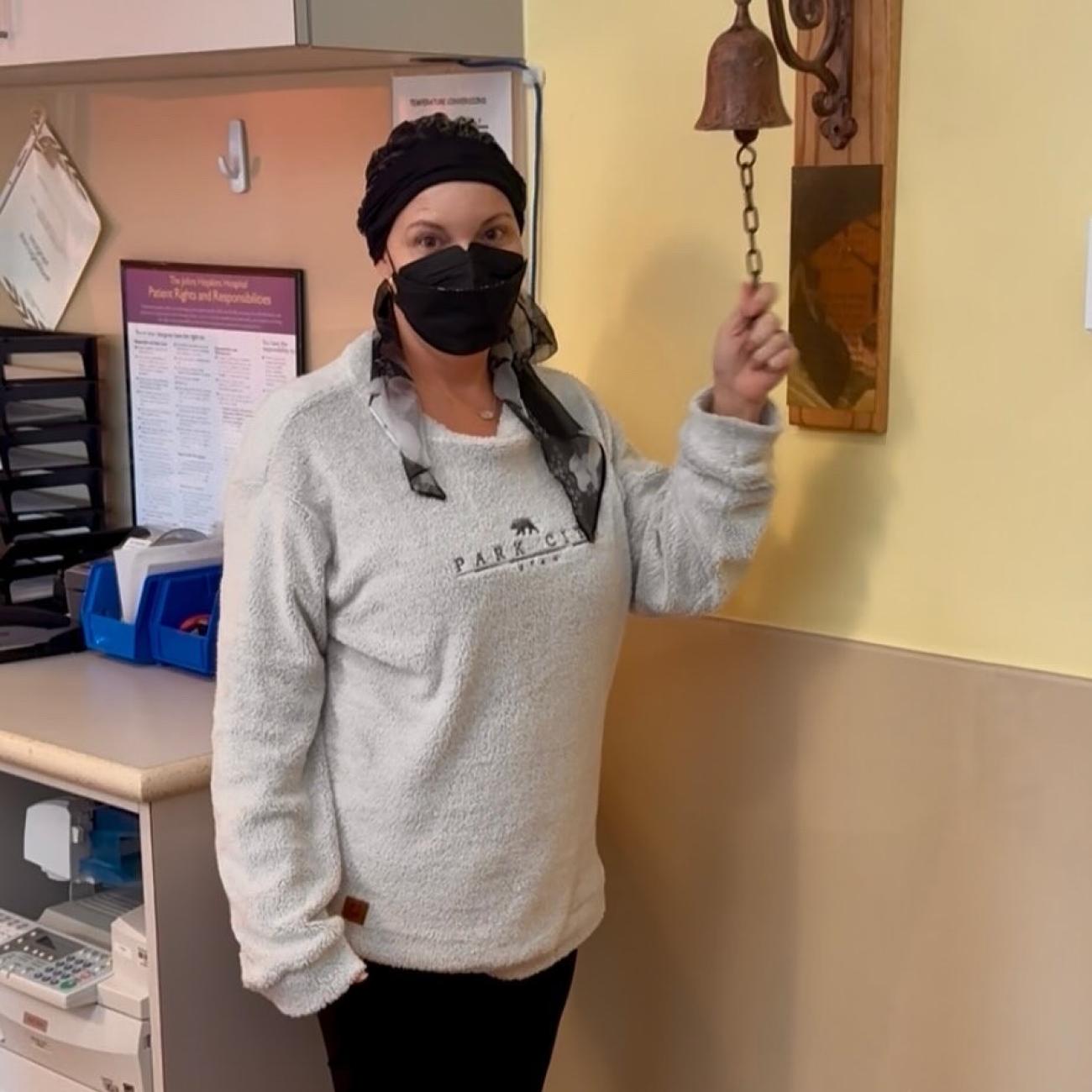
After three rounds of ATG, 7 rounds of chemotherapy chemotherapy: (kee-moe-THER-uh-pee) The use of medicines that kill cells (cytotoxic agents). People with high-risk or intermediate-2 risk myelodysplastic syndrome (MDS) may be given chemotherapy to kill bone marrow cells that have an abnormal size, shape, or look. Chemotherapy hurts healthy cells along with… , and one round of total body radiation, I received a bone marrow transplant from my anonymous donor.
Johns Hopkins uses an outpatient transplant model, which allowed me to stay with my family and push myself to keep moving each day. But recovery was still incredibly hard. I lost my hair. I was severely fatigued. The immunosuppressants made me sick, and I couldn’t take care of myself, let alone my daughters.
My husband and my mom carried everything while we lived in Baltimore for four months.
During that time, something completely unexpected happened. My donor stumbled upon a video I had posted online. The timing and details matched what she knew. We connected and realized how closely our lives had intersected.
She was also a young mom. Her cousin had been following my journey and was close friends with my aunt and uncle for over 20 years. There was no denying it, she was meant to be my donor long before I knew I needed one.
Recovery is still ongoing. I deal with fatigue, muscle loss, early menopause, and a body that doesn’t always feel like my own. I’ve had to rebuild my strength, my career, and even my sense of identity. But I’m thankful to be here.
And in many ways, I feel better than I have in a long time. I’m grateful to be a mom, a wife, and to have more time with my family. I’m incredibly thankful for the people who showed up for us and carried us through.
If you’re walking through a diagnosis or just beginning your journey, don’t lose hope. The hardest days don’t get the final say. Things can change quickly, sometimes overnight. A devastating day today, may be followed by a hopeful one tomorrow.
Be flexible. Advocate for yourself. Don’t be afraid to seek a second opinion, it may save your life.
It’s easy to ask “why me” in the beginning. I did too. It felt unfair. But now, after walking through it, I see how even the hardest parts of this journey have shaped me in ways I never expected and has made me better for it.
So instead of asking “why me,” I’ve learned to ask, “why not me?”
And I’m grateful my story gets to continue.