
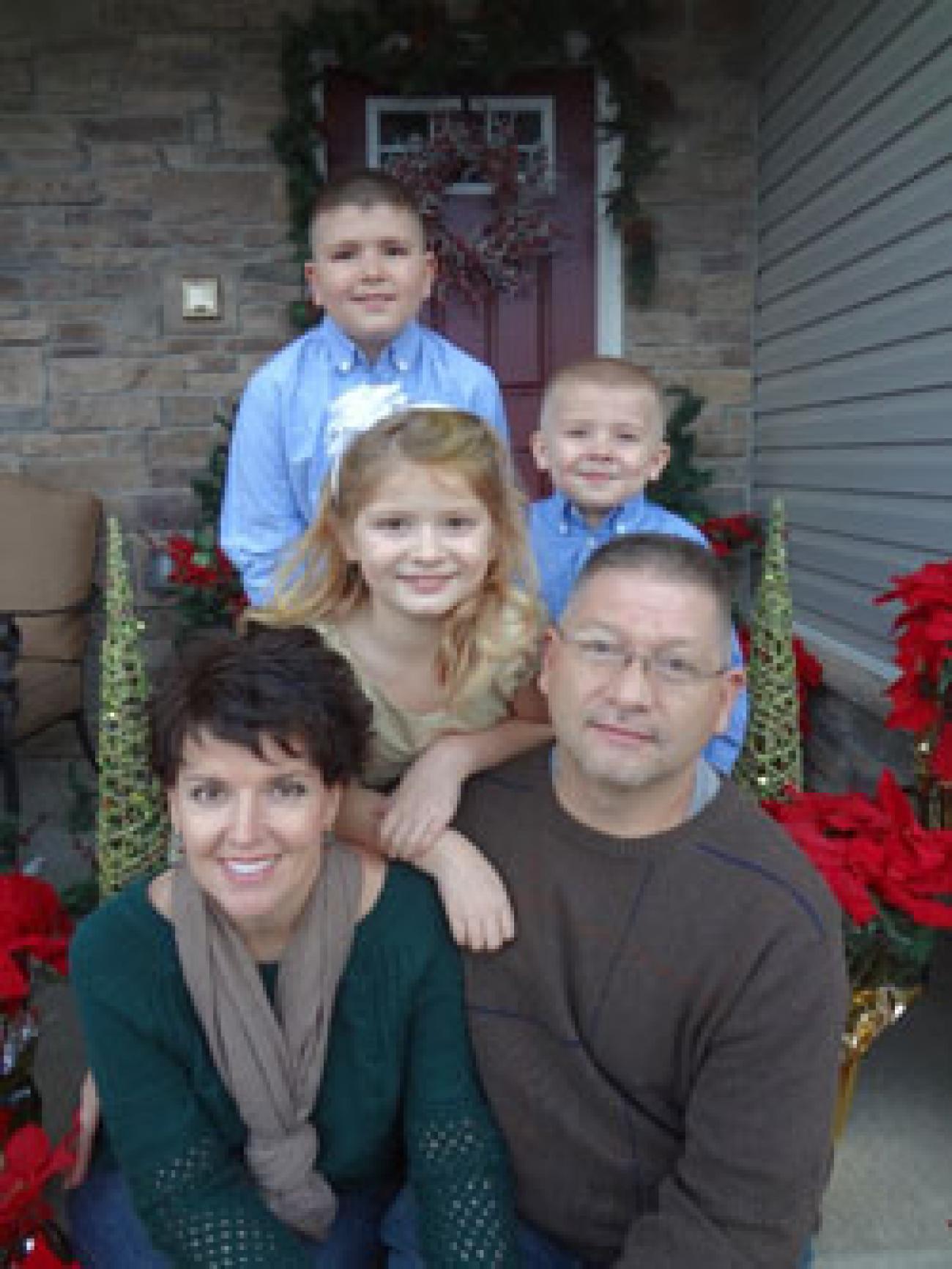
“I was fortunate to have a medical background, because with it I was able to help diagnose myself with aplastic anemia aplastic anemia: (ay-PLASS-tik uh-NEE_mee-uh) A rare and serious condition in which the bone marrow fails to make enough blood cells - red blood cells, white blood cells, and platelets. The term aplastic is a Greek word meaning not to form. Anemia is a condition that happens when red blood cell count is low. Most… and PNH,” says Dr. Heather Vega. A Pittsburgh native, she is a family physician living in Bridgeville, Pennsylvania who received her medical degree from Lake Erie College of Osteopathic Medicine.
“I was 30 years old and in a hospital-based practice 12 years ago when I noticed a bruise on my leg,” says Vega. “It was so strange because a few nights prior, I had just had a dream in which I was covered with bruises.”
“After ordering some blood work and finding that my platelets were low, I called a friend who was a hematologist hematologist: (hee-muh-TOL-uh-jist) A doctor who specializes in treating blood diseases and disorders of blood producing organs. who then referred me to a hospital in Pittsburgh for a consultation,” says Heather. “Over a month’s time and a few bone marrow bone marrow: The soft, spongy tissue inside most bones. Blood cells are formed in the bone marrow. biopsies, my blood counts continued to drop lower and lower. I was on rounds in the hospital one weekend and just had my labs done. I was neutropenic (abnormally low white blood cell white blood cell: Cells in the body that fight disease and infection by attacking and killing germs. There are several types of white blood cells including neutrophils, eosinophils, basophils, lymphocytes and monocytes. Each type of cell fights a different kind of germ. Also called WBC, leukocyte. count) and was advised to immediately go home by a friend who was a hematologist.”
“Within a week, I had an additional bone marrow biopsy bone marrow biopsy: A medical procedure to remove a small piece of solid bone marrow using a needle that goes into the marrow of the hip bone. The solid bone marrow is examined for cell abnormalities, the number of different cells and checked for scarring of the bone marrow. and was found to have aplastic anemia. My hematologists felt that I might have been a candidate for a bone marrow transplant bone marrow transplant: A bone marrow transplant (BMT) is also called a stem cell transplant (SCT) or hematopoietic stem cell transplant (HSCT).The procedure replaces unhealthy blood-forming stem cells with healthy ones and offers some patients the possibility of a cure. But for many patients, a BMT is not an option due… , but unfortunately there was no match. Over a year’s time and after being treated with cyclosporine cyclosporine: Cyclosporine is used along with antithymocyte globulin (ATG), another immunosuppressant, for treating aplastic anemia and some other forms of bone marrow failure. , steroids, ATG, and G-CSF (Neupogen®), my blood counts came back to normal,” she says.
A mother of three children with her husband Wayne Nagle, a high school business teacher, Dr. Vega required no further medications between the ages of 32 and 39.
“I felt fine. There were no problems. But two years ago, I experienced some vague abdominal pains,” she said.
Over a year’s time, she underwent multiple tests without an answer. One night, the pain became so severe that she went to the hospital, and after undergoing additional testing she was advised that it was her gallbladder. A day or so after discharge, Dr. Vega says, “A light bulb went off. Oh my God -- I have PNH. I know the signs. I Googled the symptoms for paroxysmal nocturnal hemoglobinuria paroxysmal nocturnal hemoglobinuria: (par-uk-SIZ-muhl nok-TURN-uhl hee-muh-gloe-buh-NYOOR-ee-uh) A rare and serious blood disease that causes red blood cells to break apart. Paroxysmal means sudden and irregular. Nocturnal means at night. Hemoglobinuria means hemoglobin in the urine. Hemoglobin is the red part of red blood cells. A… and emailed my hematologist who sent me for further blood work. Since most doctors have never encountered these diseases, it does make for a difficult diagnosis. But after my diagnosis, I was placed on eculizumab eculizumab: Eculizumab (Soliris ®) is given as an IV into a vein at the doctor’s office or at a special center. The procedure usually takes about 35 minutes. You will probably get an IV once a week for the first 4 weeks. Starting in the 5th week, you will get a slightly higher dose of Soliris every 2 weeks. … (Soliris®) in a twice-monthly regimen. Although I remain mildly anemic, I am managing well.
“I’m practicing again and it’s been a very interesting 12 years,” she says. “I’ve found that being diagnosed with both aplastic anemia and PNH makes me more compassionate as a doctor. It is one way I can truly relate to my patients.”
As a physician, Heather says she is a firm believer that some things happen for a reason and that we learn from those experiences. “I used to worry about little things. Now I focus on what’s really important,” says Heather. “When you are diagnosed with a bone marrow failure bone marrow failure: A condition that occurs when the bone marrow stops making enough healthy blood cells. The most common of these rare diseases are aplastic anemia, myelodysplastic syndromes (MDS) and paroxysmal nocturnal hemoglobinuria (PNH). Bone marrow failure can be acquired (begin any time in life) or can be… disease, you must keep positive and keep focused on what’s important in your life. I exercise and try and take good care of myself. And, it helps that I’m a mom. My goals for 2015 are to exercise more and continue to stay healthy.”
“I encourage patients who are newly diagnosed with a bone marrow disease to reach out to other people through AAMDSIF and visit their website,” she says. “It’s scary, but things are getting better. Reach out and connect with other patients. They are your best source for inspiration and hope.”