
I am the mother of 4 boys, now ages 13, 14, 18, and 20, and we live in North Dakota. We took our third son Samuel to the doctor just before Christmas of 2008 when he was 7, and it was about a month and many tests later that he was finally diagnosed with severe aplastic anemia aplastic anemia: (ay-PLASS-tik uh-NEE_mee-uh) A rare and serious condition in which the bone marrow fails to make enough blood cells - red blood cells, white blood cells, and platelets. The term aplastic is a Greek word meaning not to form. Anemia is a condition that happens when red blood cell count is low. Most… (SAA). The whole family was tested at the Mayo clinic for a bone marrow bone marrow: The soft, spongy tissue inside most bones. Blood cells are formed in the bone marrow. match, but none of us were a match.
Sam then received immunosuppressive therapy immunosuppressive therapy: Immunosuppressive drug therapy lowers your body's immune response. This prevents your immune system from attacking your bone marrow, allowing bone marrow stem cells to grow, which raises blood counts. For older patients with acquired aplastic anemia, immunosuppressive drug therapy is the… and he responded quickly and quite well to cyclosporine cyclosporine: Cyclosporine is used along with antithymocyte globulin (ATG), another immunosuppressant, for treating aplastic anemia and some other forms of bone marrow failure. . But once he was weaned off that drug, his platelets began a slow descent to the point where, about a year later, Mayo wanted to prep him for a bone marrow transplant bone marrow transplant: A bone marrow transplant (BMT) is also called a stem cell transplant (SCT) or hematopoietic stem cell transplant (HSCT).The procedure replaces unhealthy blood-forming stem cells with healthy ones and offers some patients the possibility of a cure. But for many patients, a BMT is not an option due… .
That was when our health insurance company said they would pay for a second opinion. We took Sam to the University of Minnesota Children's Hospital. Sam's platelets quit dropping when he was in the mid 20,000's range, and at that point the doctor felt he was not quite ready for a transplant. Since that time, his platelets gradually came up to the mid-50 and 60 thousand range, and that is where they have hovered in recent years.
Sam had not been on any medications and not needed any transfusions since the end of 2009. However, this past summer his platelets dropped to 26,000. It's been several years since we have been back to University of Minnesota, and we are consulting with a pediatric hematologist hematologist: (hee-muh-TOL-uh-jist) A doctor who specializes in treating blood diseases and disorders of blood producing organs. in Fargo, North Dakota for monitoring. With Sam's aplastic anemia, it has always primarily affected only his platelets, with other blood counts running only slightly low or low normal.
When his platelets dropped to the 20's, they ran more tests and did more marrow biopsies. The cellularity cellularity: How much of the bone marrow volume is occupied by various types of blood cells. was spotty at 10-40% but nothing else in the bloodwork stood out as being a cause or a concern. As it stands, he's not in a condition that warrants any major treatments. His hematologist is 5 hours from where we live, so a majority of the bloodwork is done locally.
For a number of months, his platelets remained low, in the mid 30’s-40. His doctor started him on eltrombopag eltrombopag: What are the possible side effects of eltrombopag (Promacta)? Get emergency medical help if you have any of these signs of an allergic reaction: hives; difficult breathing; swelling of your face, lips, tongue, or throat. Stop using eltrombopag and call your doctor at once if you have: … (Promacta®) in September, 2015, in an attempt to bring his platelets up so he could safely play basketball. After 8 weeks on eltrombopag, leading up to a maximum daily dose of 150mg, his platelets didn't budge so this drug was discontinued. In mid-December of 2015, Sam began treatment with romiplostim romiplostim: Romiplostim is in a class of medications called thrombopoietin receptor agonists. It works by causing the cells in the bone marrow to produce more platelets. Romiplostim injection is used to increase the number of platelets enough to lower the risk of bleeding, but it is not used to increase the… (NPlate®). Building up to the maximum dose, his platelets again, did not respond. We began to taper the dose to discontinue romiplostim, but during the tapering phase his platelet platelet: The smallest type of blood cell. Platelets help the blood to clot and stop bleeding. Also called a thrombocyte. count took a small jump up to 63,000. While continuing to taper, his platelets have again dropped to the 30's. The thought now is that Sam may have a delayed reaction to the romiplostim, and we are again gradually increasing the dose to see if his platelets follow suit.
Of all of our boys, Samuel is the athletic one. He loves sports and has always wanted to play football and basketball. Needless to say, his diagnosis and the low platelet counts have left him sitting on the bench doing stats or assistant coaching most years. Last year, as an 8th grader, his doctor did give him permission to play basketball, which he thoroughly enjoyed. During the season, his body was usually riddled with bruises, and I could see he didn't have near the energy the other kids on the team had. Sam is so driven and motivated that I'm afraid he doesn't realize how fatigued he is. This is how he's probably felt for half of his life, so it seems normal to him.
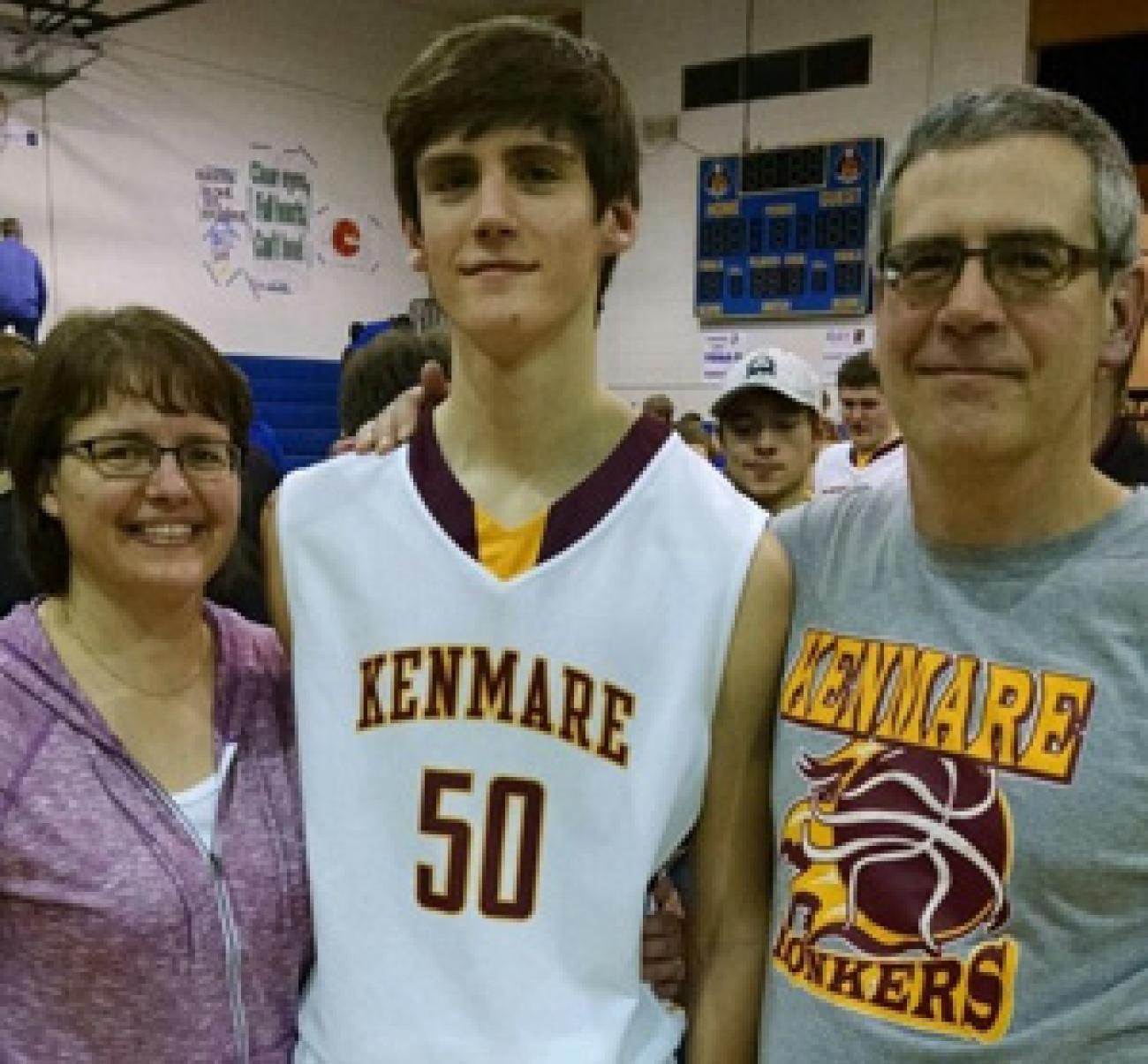
As a 6'4" freshman in high school, Sam once again participated in basketball, where he worked hard and earned a spot on the varsity team. This team was one of only eight Class B boys’ basketball teams in the state to make it to the State Basketball Tournament! In spite of the risks of being on the court, being able to be part of an awesome season has been more medicinal than any off-label injection, and has brought so much joy!
2016 Update
In September, 2016, Sam's blood counts started to drop further with his platelets at critical levels. His hemoglobin hemoglobin: A protein in the red blood cells. Hemoglobin picks up oxygen in the lungs and brings it to cells in all parts of the body. and white counts followed suit. He has been getting transfusions of platelets and/or red blood cells every week since the first part of October. Sam was seen by his transplantation doctor at the University of Minnesota and we are currently waiting for a marrow donor to be selected (there are 6 potential 8 of 8 matches for him!). We are hoping to get the transplant going by the first or second week of December. Sam is disappointed that he will miss the entire basketball season this year, but is so anxious and determined to get the transplant done. We are all expecting a GREAT outcome!