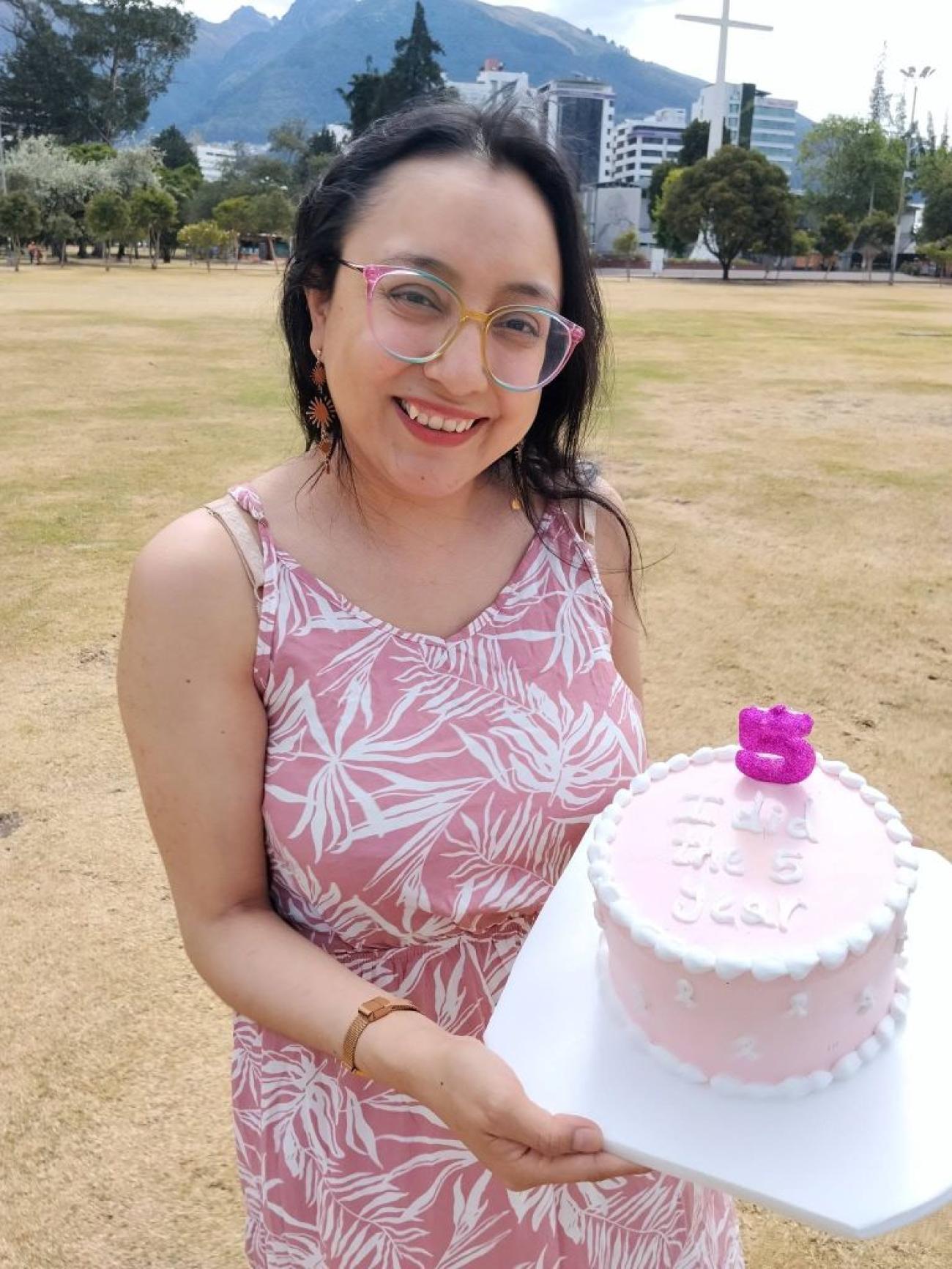
It has been five years since my bone marrow transplant bone marrow transplant: A bone marrow transplant (BMT) is also called a stem cell transplant (SCT) or hematopoietic stem cell transplant (HSCT).The procedure replaces unhealthy blood-forming stem cells with healthy ones and offers some patients the possibility of a cure. But for many patients, a BMT is not an option due… . When my first story was published, I had just gone through the entire process that led me to transplantation, and I was still learning what it meant to survive a disease that had completely changed my life.
Today, five years later, I can say that I have been able to return to Ecuador, continue my medical follow-up, return to work, study again, travel, exercise, and build new projects. I was even able to complete a second master’s degree, this time in Palliative Care. That degree was especially meaningful to me because it allowed me to transform part of my own experience into a different way of assisting other people.
But I also learned something that no one had really explained to me: surviving does not necessarily mean returning to the person you were before.
During the first year after my transplant, I was relatively stable. When my doctors tried to discontinue one medication, chronic graft-versus-host disease appeared, and I needed to remain on treatment for longer. Later, I started treatment with a different medication, which I have now been taking for about three years, mainly to control the skin manifestations of GVHD. In my case, GVHD is also present in other parts of my body, including my eyes.
GVHD was one of the things that surprised me the most because I knew it was a possibility, but I had no real idea what living with it would mean. When I was diagnosed after the transplant, I had to start looking for information on my own, learning about the disease and trying to understand what it could mean for my life.
Over time, I realized that GVHD was only one part of everything that remained after treatment.
I began noticing consequences that were not necessarily visible to other people. One of them was what is commonly called “chemo brain.” My memory did not work the way it used to. My ability to concentrate and my processing speed also changed. For someone who works with her mind and had functioned in a certain way throughout her life, discovering that some of those abilities had changed was difficult.
There were emotional changes as well. I could feel happy and grateful for my life while also going through significant changes in my mood. I learned that both things can coexist. Being grateful for life does not automatically erase the losses that come with it.
Physically, I gradually discovered other consequences. I had to face premature menopause and all the grief associated with infertility. I developed osteoporosis, along with the risk of fractures and new limitations. There were also cardiac, pulmonary, and digestive consequences. Some of them improved as the years passed; others remained.
Later, I developed neuropathy as a consequence of a severe infection, and I also had to learn how to live with that. My body became something that required much more attention than it had before.
All of this translates into very concrete things in everyday life. I no longer have the same amount of energy. I cannot do everything at the same pace or for the same amount of time. There are days when I have to organize my activities according to the energy I have available. Things that once seemed completely ordinary now require consideration.
I even obtained a disability certificate because my functional capacity is no longer what it used to be. And that is one of the hardest things to explain when a disability is not visible.
From the outside, I often look like a completely healthy person. People see that I work, travel, study, exercise, and have projects. So it is easy for them to assume that I am fine. But behind that appearance are more than ten medications a day, ongoing medical appointments, and a life that requires much more planning and care than it did before. My appointments with different specialists have become less frequent over time, which is a good sign, but they have not disappeared.
Access to medical care has also been a complicated experience. My transplant hematologist hematologist: (hee-muh-TOL-uh-jist) A doctor who specializes in treating blood diseases and disorders of blood producing organs. has been present throughout these years and has been fundamental to me. However, when problems arise involving other parts of my body, not every specialist is familiar with GVHD or necessarily knows how to adapt their decisions to someone with my medical history.
I have had doctors who approached that challenge with a wonderful attitude. They read, educated themselves, looked for information, and learned alongside me. But I have also encountered professionals who simply did not know what to do or how to respond to a situation outside what they normally see.
There is also a problem that does not depend directly on the doctors: Ecuador’s healthcare system. There are difficulties accessing appointments, tests, and treatments in a timely manner. The medications I need are not always available, and some treatments for GVHD that exist elsewhere are not easily accessible here. When a medication is available, it can also represent a considerable financial burden.
All of this means that staying stable is not something that simply happens. It requires follow-up, planning, financial resources, and, many times, persistence to find the appropriate care.
My family has also had to learn alongside me. My parents, my siblings, and my brother-in-law have been unconditionally there throughout this process. At first, there was a lot of protection, but over the years we have all learned to find a different balance: understanding what I need, what I can do on my own, and when I really need help. It has been a learning process for all of us.
My friendships, on the other hand, were one of the most painful losses. The few people who stayed during my treatment gradually drifted away. Today, only one or two remain. I think one reason is that many people simply do not know how to relate to someone living with a chronic illness chronic illness: A medical condition that lasts a long time. A chronic illness can affect a person's lifestyle, ability to work, physical abilities and independence. or an invisible disability.
They thought, like many other people did, that after the transplant I would be fine. That the transplant was the end of the story. Because I look well and can do many things, it is easy to assume that nothing is wrong anymore.
But things are still happening.
During these years, I have experienced a great deal of loneliness. A lot of it. I have also had to constantly fight for the inclusion I need and explain that a person can function, work, and participate in society while still needing accommodations and having limitations that are not visible.
The people who have remained by my side have been fundamental. My parents, my siblings, and my brother-in-law continue to be my most constant support system. So does my best friend, whom I have known since childhood, and her family. Her children have even become an important motivation for me. She has been present, has tried to understand me, and has remained there even when she probably could not fully understand what I was experiencing.
There is also my partner, who met me after everything had happened and chose to share his life with me, knowing that my story came with many things that are not always easy to understand. He, too, has had to learn with me what it means to live with a chronic illness and its consequences.
One of the things I most wish I had received during the transplant process was more information about what could come afterward.
I knew GVHD was a possibility, but I did not really understand how it could change my life. After I was diagnosed, I had to search for information on my own, learn about the disease, and try to prepare myself for something I did not know how to face. I also had to discover many of the possible long-term consequences on my own.
I understand that doctors have to find a balance between informing patients and overwhelming someone who is still trying to survive. But I believe knowing these possibilities does not necessarily take away hope. On the contrary, it can help us prepare.
I believe patients need to know that the outcome of a transplant is not measured only in terms of survival.
Of course, surviving is the most important thing. But another stage begins afterward. The body can change. Some abilities may not fully return. Conditions or consequences that no one expected may appear. You may have to learn to live differently.
And that does not mean that life stops being good.
My relationship with my transplant hematologist has been one of the most beautiful parts of this process. He is someone who knows my history, my changes, my fears, and my progress. Over the years, our relationship has become much more than simply a patient-doctor relationship.
There is something that gives me enormous peace: I know that whatever happens to me, he will find a way to look for a solution or the best possible path for me. That certainty gives me a sense of safety.
But there is something else that has been fundamental: he believes in me. He believes that I am capable, even when I have moments when I doubt what I can do myself. That trust makes me feel powerful. It reminds me that I am not simply a patient with a list of diagnoses and treatments. I am a person who can continue building her life.
And for me, that is also a form of support.
Over the years, many of the other specialists who care for me have also become very important people in my life. After so many years, going to the hospital no longer feels like simply going somewhere to receive medical care. Many times, it feels like returning to a second home. I feel cared for, protected, and supported. They know my history and pay attention to details that I sometimes overlook myself.
Today, I can say that I am doing much better than I was during those first years. I work. I travel. I exercise. I have projects. I continue studying. I continue building a life that I like.
But my life is not the same as the one I had before I became ill.
Now I need more care, more planning, and more awareness of my own body. I have to decide how to use my energy, organize my days differently, and accept that some things that once felt automatic now require effort or simply cannot be done in quite the same way.
For a long time, I thought recovery meant becoming who I was before. Now I understand that recovery meant learning who I am after everything that happened.
The transplant did not give me back exactly the life I had. It gave me the possibility of building another one. A life with limitations I did not expect, losses I am still processing, and needs that will probably remain with me for many years, but also a life in which I continue working, loving, traveling, learning, and making plans.
I think that is also part of what surviving a transplant means: not only learning how to live after it, but learning to recognize that life can continue, even when it has to continue differently.
To read Stefania's first story, please follow this link: https://www.aamds.org/patient-chronicles/stefania-erazo