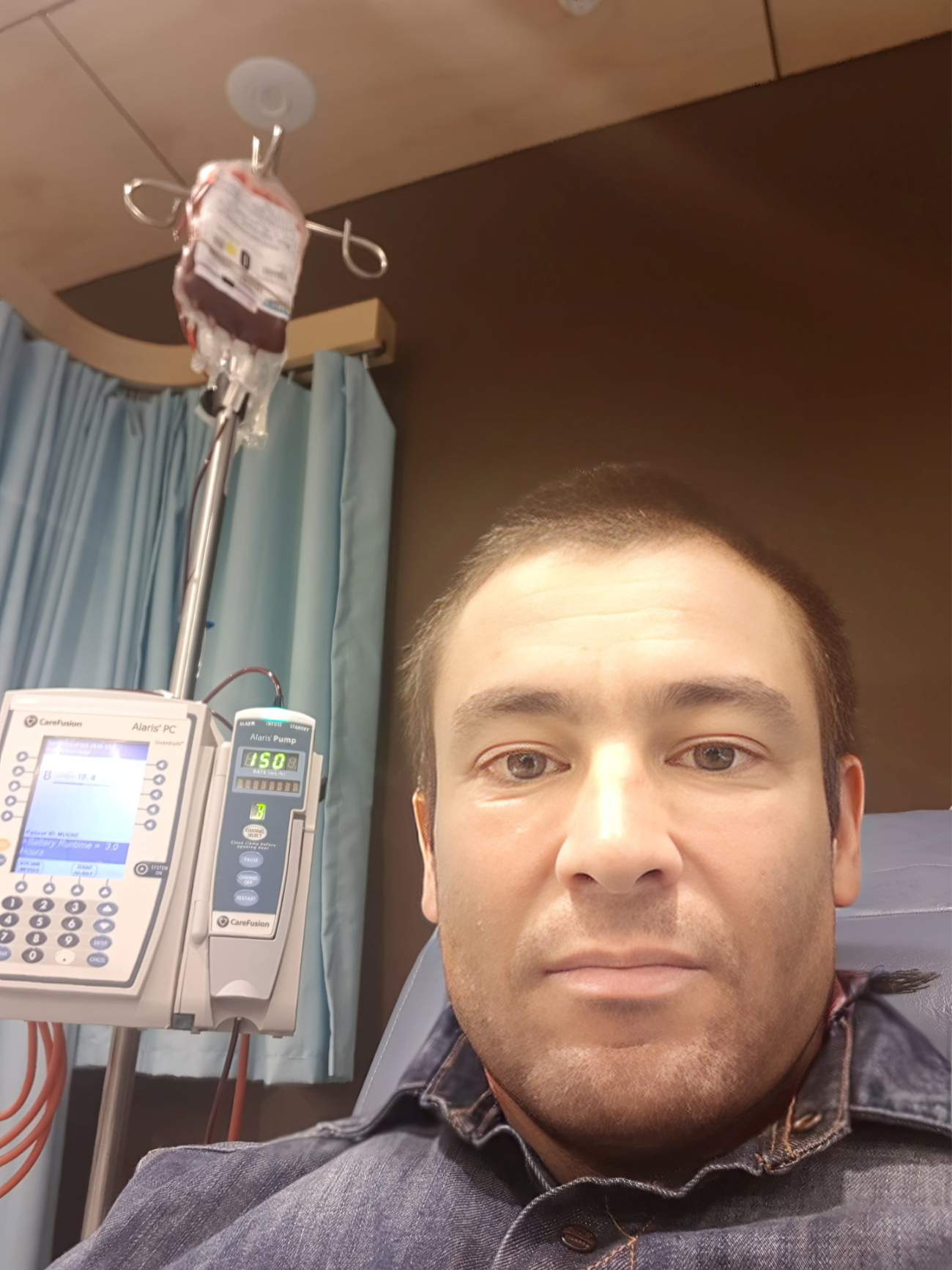
In 2009, Daniel had a good job in accounting in Sydney, Australia. He had a structured, organized, healthy lifestyle. He had a devoted partner (whom he later married) and was studying for the Chartered Accountancy qualification. He rode his bike to work and played soccer. He was planning a good life ahead.
One day at the office, the receptionist pinched his arm. The next day, he saw a huge welt in the same spot. Because a colleague urged him to get it checked out, he did.
The next day, at 8:47am, the call came: come get your results immediately. After waiting for hours in the Emergency Department, he left to call his GP (primary care doctor.) That decision turned out to be the best one: within a week, his doctor had secured an appointment with the best specialist in Sydney.
After more blood tests, Daniel continued to go to work. The specialist called him in for a bone marrow biopsy bone marrow biopsy: A medical procedure to remove a small piece of solid bone marrow using a needle that goes into the marrow of the hip bone. The solid bone marrow is examined for cell abnormalities, the number of different cells and checked for scarring of the bone marrow. and gave him platelets. The diagnosis was Aplastic Anemia Aplastic Anemia: (ay-PLASS-tik uh-NEE_mee-uh) A rare and serious condition in which the bone marrow fails to make enough blood cells - red blood cells, white blood cells, and platelets. The term aplastic is a Greek word meaning not to form. Anemia is a condition that happens when red blood cell count is low. Most… . It was May, and his treatment began in July with Horse ATG. After 9 days, he came home, showing good progress with the ATG. His PICC line was removed after only two weeks, although he returned for platelets every two weeks.
After three months at home, he attended family events again. By early 2010, Daniel began playing soccer again. In March, his daughter Mila was born. He started working again, as an independent Public Accountant. Yet his platelets never tested past 100.
Daniel experienced emotional changes, too. It took some time for him to regain his sense of empathy. Yet by Halloween, he bought a home for his growing family. In 2011, life was very good, concluding with being married to his partner in Scotland and honeymooning in Iceland, then touring France, Italy, and Spain. His wife became pregnant with their second child, and they moved to a new home.
Then, in 2012, a new shock: his son Tudor became very ill. On a trip to Melbourne to see family, Tudor was taken to the local GP, who advised that he be taken straight to the ED. This little boy, only 9 months old, spent two weeks in critical condition and two months in Melbourne while the Children's hospital worked to find a cause. The diagnosis of Hyper IGM meant a stem cell transplant. The best option to treat him was with cord blood stem cells stem cells: Cells in the body that develop into other cells. There are two main sources of stem cells. Embryonic stem cells come from human embryos and are used in medical research. Adult stem cells in the body repair and maintain the organ or tissue in which they are found. Blood-forming (hemapoietic) stem… . In late 2013 he had BMT and he recovered well!
By 2014, life was back to normal. The children attended preschool and life was good. In 2016, Daniel began racing motorcycles. He became an ambassador for his professional association. Late in the year though, he separated from his spouse.
At an association event far from home, he began feeling fatigued. He found a half-orange sized lump that arose from a minor bump when playing soccer. After flying home, he slept the entire afternoon.
Over the following weeks, Daniel noticed dark urine each morning. He saw a nutritionist due to feeling fatigue, they recommended bloodwork. Sensing an old feeling, he used the blood request forms he had from his specialist, then also made an appointment with the Professor at his hospital. It was December. The diagnosis was PNH. While this explained his swollen knee and fatigue, he knew the diagnosis was very serious. He waited until after Christmas to tell anyone.
In 2017, he began treatments with Soliris, every two weeks. On the alternate weeks, he received platelets, and sometimes red blood cells also. He felt fit enough to get things done, but the fatigue remained. He tried to get into
clinical trials
clinical trials:
Clinical research is at the heart of all medical advances, identifying new ways to prevent, detect or treat disease. If you have a bone marrow failure disease, you may want to consider taking part in a clinical trial, also called a research study.
Understanding Clinical Trials
Clinical…
, but his counts were too low to qualify. Ultimately, his specialist recommended a
bone marrow transplant
bone marrow transplant:
A bone marrow transplant (BMT) is also called a stem cell transplant (SCT) or hematopoietic stem cell transplant (HSCT).The procedure replaces unhealthy blood-forming stem cells with healthy ones and offers some patients the possibility of a cure. But for many patients, a BMT is not an option due…
.
By this time, Daniel had been practicing yoga and been seeing his therapist. He worked hard to stay “in the moment,” helping to reduce anxiety about the unknown as he prepared for transplant in January 2018. The preparation and transplant day went well.
As the new stem cells started to engraft, Daniel suddenly developed kidney issues, so both his engraftment engraftment: Refers to how well a graft (donor cells) is accepted by the host (the patient) after a bone marrow or stem cell transplant. Several factors contribute to better engraftment - physical condition of the patient, how severe the disease is, type of donor available, age of patient. Successful… and his kidneys were being monitored. By the end of February, his blood counts began falling. The Hospital scheduled his second transplant after his son’s birthday in March. He had the same donor, a young man from Germany.
As before, his cells started to engraft, but then rejection began. He came home in April, but returned to treat C-Diff. He was released, but then returned for more issues. By the end of June, he had spent over 12 weeks in hospital in several admissions, the specialist told him that he was in a “precarious position,” or as Daniel translated, on the razor’s edge. He had few antibodies and was sent for another Bone Marrow Biopsy.
Even though he was sent home again, he focused on each day at a time. Setting small goals, a week without a hospital admission, then two weeks, then a whole month went by without an admission. His mother, Marion, moved in with him to help, who doted on him with big English breakfasts. After two months, he decided to go to his family’s hobby farm, trying to spend time in the country to build up his strength.
Although he was five hours from home, he stayed longer as he was feeling better being in the countryside. The Red Cross network would fly his necessary blood draws from Sydney to Port Macquarie (The Mid North Coast of Australia) an hour's drive from where he was living. He ended up staying in the countryside for three months.
While Daniel was living on the farm, he took walks in nature, which mended his spirit. He felt more positive, and little by little, increased the length of his walks each day. He felt better and did more. Eating at the local cafe, he had big, healthy meals, and he gained back some of the weight he’d lost. He even felt good enough to do gardening, general maintenance and cut down dying trees on the farm. When he returned home, he looked and felt much improved over when he left.
While he was away, his specialist researched why his transplants failed. They discovered a DNA aberration that he had but the donor didn’t. Then his immune system attacked the donor stem cells because it didn’t recognize that DNA. When the specialists searched again for a different donor, they only found two in a worldwide search. Only one was available, a woman in the UK, with two children and aged 54.
In the first week of December, Daniel had his third transplant, within the same year. This time, it was a “textbook” experience. He said that he could feel the warmth of these cells in his chest, like a mother’s unconditional love. Yet by mid-January, he was back in the hospital. He lost all the weight he’d gained as he suddenly couldn’t eat and felt horrible. For the first time ever he called for an ambulance to take him to the hospital. This was a diagnosis of GVHD, a staph infection, and on top of that, Sepsis. By the time he was released from the hospital, his weight was down 10 kilos, about 22 pounds.
Slowly he started feeling better. He was able to have blood collection performed at home. Since going to the farm helped so much between the last two transplants, he decided to return there, this time staying for 18 months.
As he came home to the farm one day, he started having rigors (uncontrollable shaking.) He returned to the hospital and was admitted over the weekend. This was to be the last time he ever had to stay the night in a hospital. Following that stay and over the coming months he became fully engrafted, which he could feel happening. He had fewer transfusions, completely tapering off by the end of 2019, making his own red blood cells and Platelets natively.
In early 2020, the PICC line was finally removed. This was also when the global Coronavirus Pandemic came to Australia. To isolate, Daniel returned to the farm. His neighbors checked on him as they all endured lockdown. By the end of 2020, the specialists told him, “You are well now.” The only monitoring necessary was iron levels. “Go and live your life” was their final instruction.
Even though he needed therapeutic phlebotomy over 18 months to remove excess iron from his blood, his final one was mid 2024 as normal life returned. Recently he started traveling again, a trip to Dresden Germany for the World Transplant Games. He said that he was “no longer worried about fatigue” because he only got tired like everyone else.
What advice does Daniel give after enduring all these years and these treatments? First, he says that patients must be “doggedly determined” to persevere. He says he was unwilling to deter from what he wanted for himself. He adds, “Each day, be as present as you can possibly be. Don’t be attached to distant plans, but know you can maintain hope for yourself. Hope exudes from love and care, and you can live without fear.” He suggests that yoga and meditation can greatly assist you, as you learn to be present.
Daniel recommends, “Be present, loving, and accepting.”