
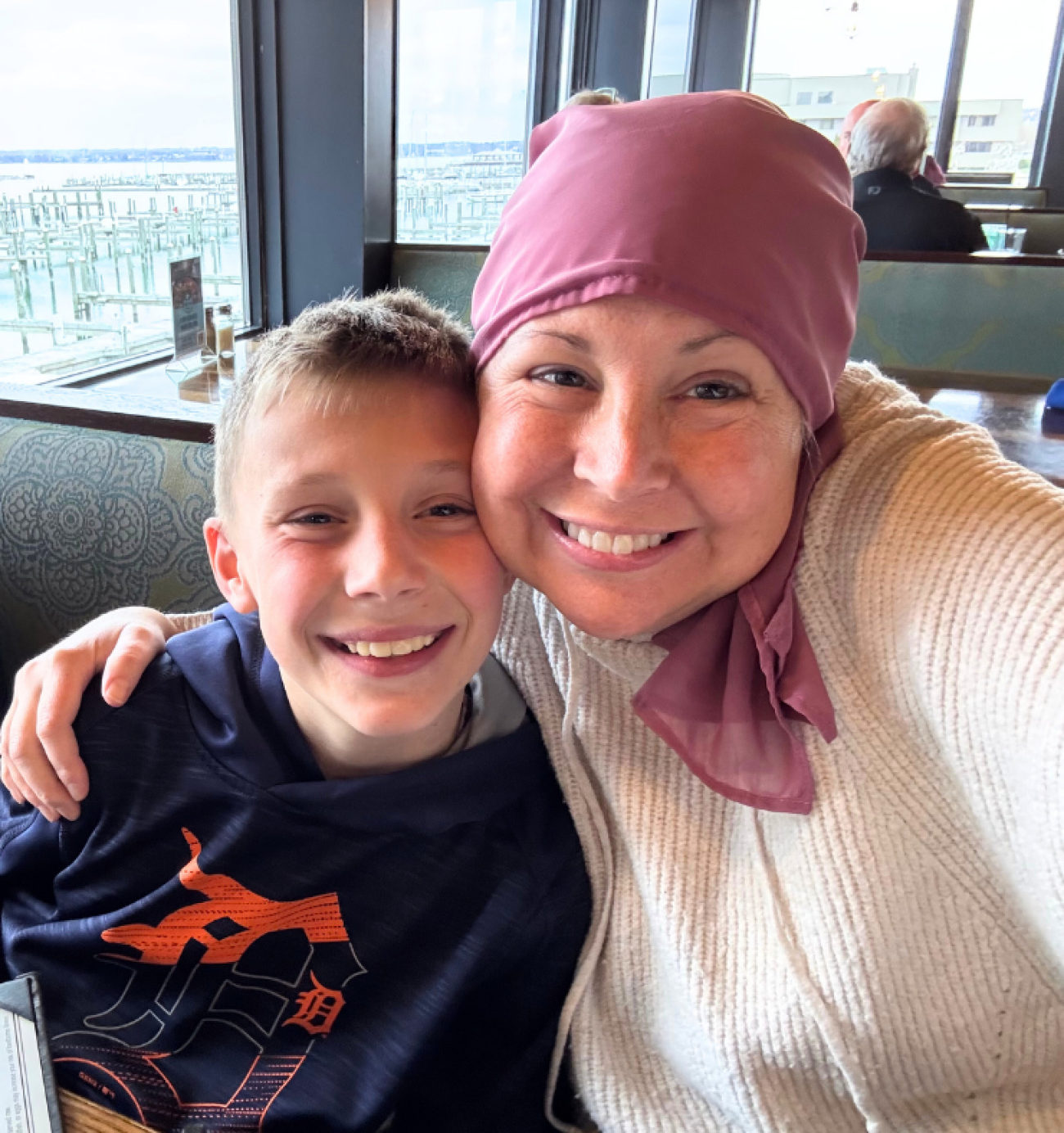
Jen had a great life. She was married with two children, and she’s just transitioned from teaching to school counseling. At 41, life was busy yet wonderful.
Her symptoms were unusual, but not alarming. The leg pain was new, as was the bruising. Then fatigue set in, far beyond usual tiredness from her schedule. A visit to the doctor did not offer a definitive diagnosis. They suggested it was her condition with Hashimoto's thyroiditis, but with the new bruising, they ordered labs. It was February 2022.
The following day, the doctor herself called, asking that she repeat the tests. Jen also noticed petechiae petechiae: (puh-TEE-kee-ie) Small, flat red or purplish spots on the skin, caused by bleeding. It is often a symptom of a low platelet count. on her feet. The next call caught her off guard. Jen was in the grocery store parking lot when her doctor called with the news: she was making an urgent referral to a hematologist hematologist: (hee-muh-TOL-uh-jist) A doctor who specializes in treating blood diseases and disorders of blood producing organs. at the cancer and hematology center, noting the extremely low platelet platelet: The smallest type of blood cell. Platelets help the blood to clot and stop bleeding. Also called a thrombocyte. count. Jen was stunned and shaken. She returned home without groceries, stunned by the thought she may have cancer.
The appointment was with a non-malignant hematologist who ordered additional testing. The diagnosis was then ITP. While being treated, she continued to be tested every two weeks, showing that her platelets kept dropping. She was treated with iron, B12 injections, and steroids because mild anemia anemia: (uh-NEE-mee-uh) A condition in which there is a shortage of red blood cells in the bloodstream. This causes a low red blood cell count. Symptoms of anemia are fatigue and tiredness. was presented.
Her platelet and hemoglobin hemoglobin: A protein in the red blood cells. Hemoglobin picks up oxygen in the lungs and brings it to cells in all parts of the body. counts kept dropping. The hematologist considered performing a bone marrow biopsy bone marrow biopsy: A medical procedure to remove a small piece of solid bone marrow using a needle that goes into the marrow of the hip bone. The solid bone marrow is examined for cell abnormalities, the number of different cells and checked for scarring of the bone marrow. in the office, but the day of the procedure they postponed it because her platelet levels dropped. 24 hours later, her platelet level had declined to critical levels. Jen was sent to the hospital for the bone marrow biopsy. At this point, no one had considered a diagnosis of Aplastic Anemia Aplastic Anemia: (ay-PLASS-tik uh-NEE_mee-uh) A rare and serious condition in which the bone marrow fails to make enough blood cells - red blood cells, white blood cells, and platelets. The term aplastic is a Greek word meaning not to form. Anemia is a condition that happens when red blood cell count is low. Most… .
The biopsy results ruled out leukemia and Hodgkin’s lymphoma. They suggested that aplastic anemia was not the cause, either. Without a good diagnosis, her biopsy was sent for further analysis. Jen waited at the hospital for two weeks not knowing what the diagnosis could be.
Not only was Jen worried, but her condition also deteriorated. Platelet transfusions did not result in enduring platelet levels. The doctors considered selecting HLA HLA: See human leukocyte antigen. -matched platelets if her counts fell below 10,000. Jen was on a roller coaster emotionally and physically fragile as well. She had blood draws daily.
Another bone marrow biopsy was ordered by a new specialist. This time, cellularity cellularity: How much of the bone marrow volume is occupied by various types of blood cells. had decreased and the diagnosis came back: Severe Aplastic Anemia.
Jen was completely transfusion-dependent at this point. She received platelets two to three times each week, and blood every week. As part of evaluating her for a stem cell transplant, Jen’s sisters and cousins were tested for a match. None was a suitable match to help her, so she started HATG.
She had no severe complications from the treatment, so she was allowed to go home. For the near term, she still needed transfusions, but gradually she improved enough to avoid transfusions altogether. She continued having blood tests every two weeks. Jen returned to work and started weaning off cyclosporine cyclosporine: Cyclosporine is used along with antithymocyte globulin (ATG), another immunosuppressant, for treating aplastic anemia and some other forms of bone marrow failure. .
A little over a year later, she was happy to go on a family vacation. She seemed more tired than usual on the hikes, but she thought it was because she was out of shape. The next bloodwork showed her counts were dropping slowly. The doctor increased the dosage of cyclosporin, but her counts continued to decline.
After a month, Jen was transfusion-dependent again. Because there was no familial match, the specialist decided to try rabbit ATG since she received horse ATG previously. She had no response initially, but she was allowed to go home if she was extremely careful, needing to wait four months to see if it worked.
Jen’s local doctor recommended a consultation with a different specialist at the University of Michigan, who recommended a transplant as soon as a match was found. She remembers the Zoom call in November 2023 with the specialist, her husband at her side: they found a 7(8) donor, with no antibody issues. The donor would be available now or two months later, so they chose now! She started prep for transplant.
Jen says this was “the absolute hardest thing I have ever done in my entire life, leaving for the hospital and leaving the kids to travel across the state not sure how things would work out.” Her mother would stay at her house with the kids, and her husband would make a 2 hour trip home each weekend to be with their kids. She says that radiation left her shaking for 24 hours. Prep was so much harder than she expected, including chemotherapy chemotherapy: (kee-moe-THER-uh-pee) The use of medicines that kill cells (cytotoxic agents). People with high-risk or intermediate-2 risk myelodysplastic syndrome (MDS) may be given chemotherapy to kill bone marrow cells that have an abnormal size, shape, or look. Chemotherapy hurts healthy cells along with… , radiation, and another round of ATG.
As transplant day approached, she received updates as the cells were extracted and sent. The hospital kept them up to date as the life-bringing cells flew from overseas to Michigan. Transplant day, December 20th, itself was anticlimactic; the procedure was similar to a transfusion. For Jen, the hardest part was missing her kids because they had not been allowed to visit.
Hair loss was traumatic for her. Jen worried about her kids, concerned that in video calls, seeing her without hair would make her look sick. When her hair started to fall out, she asked her sister to cut it all.
Jen’s blood counts were slow to recover after transplant, but days +8 and +9 the counts started to rise. Although they celebrated Christmas with the kids before she entered the hospital, Christmas day was so hard, being away from her kids and family. On January 4th, she was released to continue waiting the 100 days at the Air BnB rental they found. She was eating and healing, except for the frequent journeys for bloodwork, where they had to travel over brick roads that jostled her tender tummy (she kept a puke bucket in the car.)
After transplant, Jen only had two readmissions, for a norovirus and for kidney complications. She only experienced mild skin GVHD, dry patches and rashes. The Tacrolimus Tacrolimus: Tacrolimus is in a class of medications called immunosuppressants. It works by decreasing the activity of the immune system. Tacrolimus can be prescribed to treat and prevent graft vs host disease (GVHD). It can also be used as part of combination therapy to treat aplastic anemia in place of… caused hand tremors so they switched to Jakafi, which worked well through the two years post-transplant. In 2024, a kidney biopsy after labs showed continued excess proteins and elevated creatine levels. The diagnosis was TMA. The doctors were a bit shocked as labs did not indicate this rare complication from transplant. Luckily, the infusion treatments worked well. She had physical therapy to help regain the muscle mass she lost during the long journey leading up to and during treatments.
Two years later, Jen is still healing, finding joy and telling her story. Although she doesn’t know if returning to teaching is in her future, she is constructing a new normal. She found hair extensions to help give her the length she used to have. She revels in the little things, like driving her children to school.
Jen says there are lots of “hard things” about her journey. The financial burden is real, especially with having to add the cost of the rental after treatment. She had to be away from her children for so long, missing Christmas and other milestones. Because her mom stayed with the children, her extended family provided meals, and her family helped with caregiver roles, her husband had time to go home to the children. She says they all helped bring her through the multiple hospital stays. She approaches her 2nd Re-Birthday with joy and gratitude. Jen says, “it’s all about God’s timing.”
Jen has several words of advice for other patients. “Keep the faith! It is a journey with lots of ups and downs but a great gift at the end.”
She also reveals this about herself: she says she was a little naïve about the process. She advises patients that “There will be hiccups along the way. But it is so scary. Stay off the internet. Make sure you have a good “fit” with your doctors so you can trust and can ask the questions you want to ask the internet. And join a support group so you can learn from others, like they helped me." The last four years since diagnosis have been life-changing in so many ways. Jen has a new appreciation for life and chooses to find joy in the journey.”