A grim prognosis
In 1989, all three of Norma Good’s blood counts were found to be abnormally low. The hematologist hematologist: (hee-muh-TOL-uh-jist) A doctor who specializes in treating blood diseases and disorders of blood producing organs. in her home town admitted to not knowing how to handle her rare bone marrow failure bone marrow failure: A condition that occurs when the bone marrow stops making enough healthy blood cells. The most common of these rare diseases are aplastic anemia, myelodysplastic syndromes (MDS) and paroxysmal nocturnal hemoglobinuria (PNH). Bone marrow failure can be acquired (begin any time in life) or can be… condition, so he referred to her to a local clinic which didn’t offer much hope for survival. Not easily deterred, Norma sought out a clinical trial clinical trial: A type of research study that tests how a drug, medical device, or treatment approach works in people. There are several types of clinical trials. Treatment trials test new treatment options. Diagnostic trials test new ways to diagnose a disease. Screening trials test the best way to detect a… at the National Institutes of Health (NIH) in Bethesda, Maryland. “The NIH is wonderful,” she says. “They’re doing their best to combat these diseases, and they’re making improvements all the time. We need to encourage people to realize how much better things are now.”
Norma’s initial diagnosis had been aplastic anemia aplastic anemia: (ay-PLASS-tik uh-NEE_mee-uh) A rare and serious condition in which the bone marrow fails to make enough blood cells - red blood cells, white blood cells, and platelets. The term aplastic is a Greek word meaning not to form. Anemia is a condition that happens when red blood cell count is low. Most… , but 18 months later, her diagnosis was changed to MDS. She searched for information about her extremely rare condition. AA&MDSIF was a relatively new organization in the 1980s, but it provided her with support. “The people at AA&MDSIF were wonderful. There was a local chapter near where I lived in Cleveland, and some caregivers for another patient were very supportive of me as well,” says Norma.
A long battle
Over the three and half years after her diagnosis, Norma battled her low blood counts with several treatments. Throughout the process, she received blood transfusions blood transfusions: A blood transfusion is a safe and common procedure. Most people who have a bone marrow failure disease like aplastic anemia, MDS or PNH will receive at least one blood transfusion. When you receive a blood transfusion, parts of blood from a donor are put into your bloodstream. This can help some… every seven to ten weeks. She had over ninety transfusions altogether, each with 1-4 units. Initially, she received both platelets and red cells, but after three months she was given only red cells.
The first treatment Norma tried was antithymocyte globulin antithymocyte globulin: ATG is an immunosuppressant, a drug that lowers the body's immune response. It is typically used with cyclosporine as the first-line immunosuppressive therapy (IS) to treat patients with acquired aplastic anemia. In some cases it is used as a treatment for patients with MDS and PNH. (ATG). She experienced serum sickness serum sickness: An immune system reaction to foreign proteins in certain medicines. Serum sickness can be a side effect of ATG, causing fever, rash, joint pain, and muscle aches. from the treatment, consisting of a rash and fever. But she says, “I don’t want to scare anyone. It wasn’t pleasant as it was put into the body, but it only took about eight hours, so it wasn’t too bad.” However, ATG proved to be ineffective for her.
Norma’s next treatment was a growth factor growth factor: A substance made by the body that stimulates the bone marrow to produce blood cells. Some growth factors are man-made in the laboratory and used for treating low blood counts. These include red blood cell growth factors called erythropoietin (EPO) and darbepoetin, and white blood cell growth… protocol protocol: An action plan that describes what will be done in a clinical trial and how it will be carried out. This plan is reviewed and approved by a committee at each place doing the clinical trial. This committee is known as the Institutional Review Board. . She received three growth factor treatments over the following three years. The fi rst growth factor treatment was GM-CSF (Leukine®). This treatment made her feel extremely sick, with after effects that were similar to chemotherapy chemotherapy: (kee-moe-THER-uh-pee) The use of medicines that kill cells (cytotoxic agents). People with high-risk or intermediate-2 risk myelodysplastic syndrome (MDS) may be given chemotherapy to kill bone marrow cells that have an abnormal size, shape, or look. Chemotherapy hurts healthy cells along with… . She says, “The most difficult thing about it was deciding to continue the protocol after the extreme sickness I experienced with the treatment.”
However, Norma was unwilling to give up, so she spent eight weeks at the NIH receiving another growth factor treatment, interleukin-3 (IL-3). After these eight weeks, she received treatment with G-CSF (Neupogen®). She experienced no major side effects from what was to be her final treatment. After more than three years of undergoing treatments, her blood counts started to rise, and she finally went into remission.
A different battle
In addition to her medical issues, Norma faced continuous problems with her insurance. She was forced to change her hospitalization plans three times during her treatments. She also turned 65 during this time, which constituted further changes for her insurance. Fortunately, she didn’t have to pay for medications while enrolled in the NIH trial, and social workers at NIH helped her navigate her insurance problems.
Norma also found support in her husband, who stayed by her side throughout the entire ordeal. In the three and half years before she went into remission, she was able to maintain a fairly normal life. During her treatments, she found substitute teachers to teach her classes, and between treatments she went to work every day, scheduling her blood transfusions around her regular work hours.
There is a tomorrow
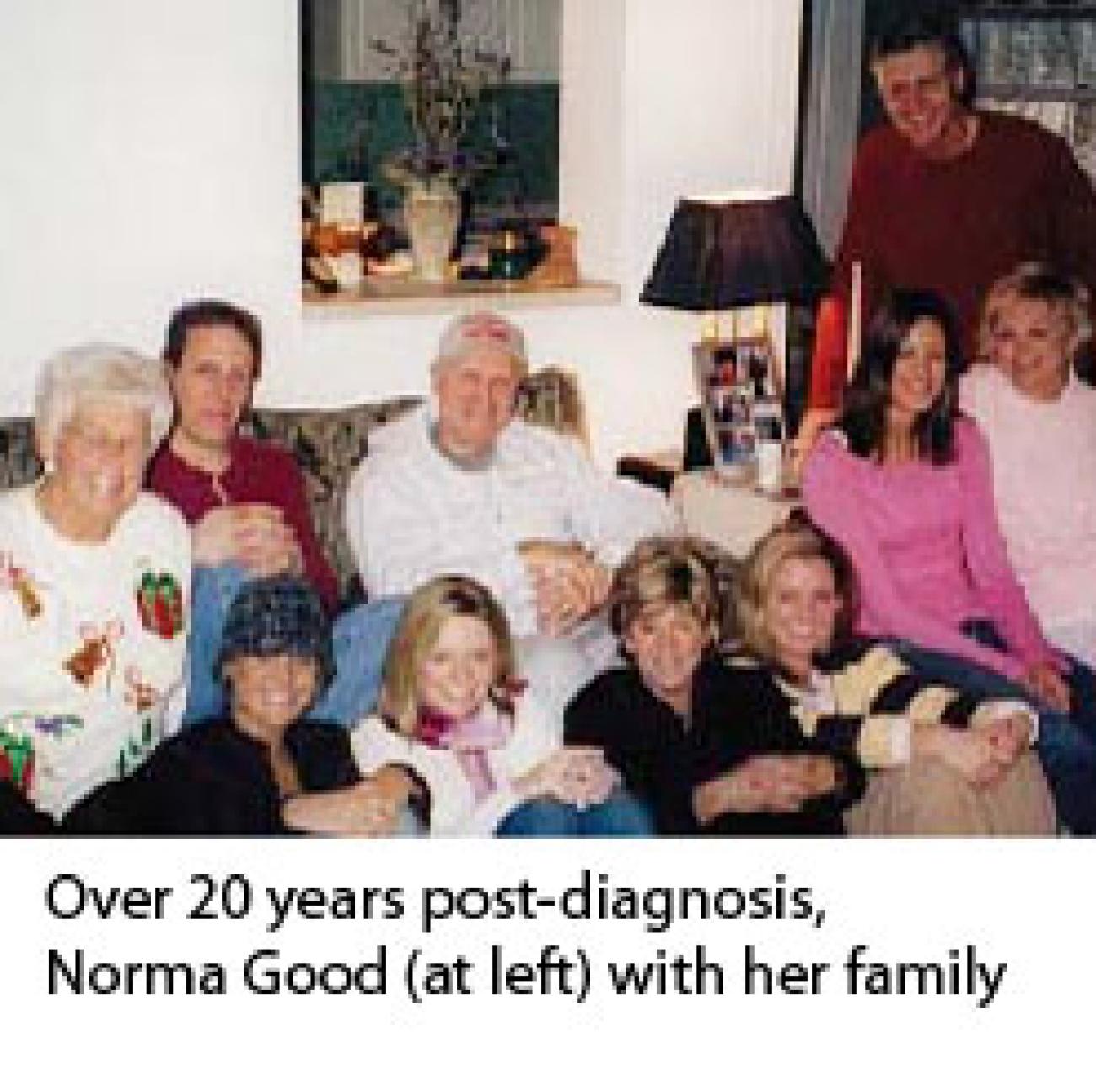
Norma has been in remission for eighteen years. She has become an active speaker for her local blood bank. Her slogan is, “There is a tomorrow—and there is a tomorrow because you’ve given blood.” Her message is that if people hadn’t taken the time to give blood, she wouldn’t be able to be here. As she tells people, “It’s scary when there’s a shortage of blood and you depend on it.”
Norma’s advice to other patients is to not be shy about seeking help. “When AA&MDSIF asks if you want a volunteer to call you, LET them call you. It helps to talk to someone who’s been through it.”
She also advises people to be patient, and above all, to have faith. “After two years of treatment, I didn’t think that things were going to ever change, but after three and a half years, it finally turned,” says Norma. “You have to say I WILL get through this. I want to live. The fact that I’m still here after 22 years speaks to the fact that you can survive this disease.”