

 The
Aplastic Anemia
Aplastic Anemia:
(ay-PLASS-tik uh-NEE_mee-uh) A rare and serious condition in which the bone marrow fails to make enough blood cells - red blood cells, white blood cells, and platelets. The term aplastic is a Greek word meaning not to form. Anemia is a condition that happens when red blood cell count is low. Most…
& MDS International Foundation developed
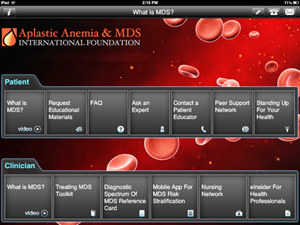
this FREE iPad app, available from the iTunes store as an educational resource for clinicians and patients.
The
Aplastic Anemia
Aplastic Anemia:
(ay-PLASS-tik uh-NEE_mee-uh) A rare and serious condition in which the bone marrow fails to make enough blood cells - red blood cells, white blood cells, and platelets. The term aplastic is a Greek word meaning not to form. Anemia is a condition that happens when red blood cell count is low. Most…
& MDS International Foundation developed
this FREE iPad app, available from the iTunes store as an educational resource for clinicians and patients.
Clinicians can use the What is MDS? video (below or on our Youtube channel) as a resource when teaching patients about myelodysplastic syndromes myelodysplastic syndromes: (my-eh-lo-diss-PLASS-tik SIN-dromez) A group of disorders where the bone marrow does not work well, and the bone marrow cells fail to make enough healthy blood cells. Myelo refers to the bone marrow. Dysplastic means abnormal growth or development. People with MDS have low blood cell count for at… (MDS). Other resources include:
- Treating MDS Toolkit (includes patient education materials)
- MDS Risk Classification mobile app
- Diagnostic Spectrum of MDS, MDS/MPN, and Myelofibrosis Reference Card
- Nursing Network
- Health Professionals Connection newsletter.
Patients and their families can use the iPad app to learn about MDS in several ways:
- Watch the What is MDS? video above or on our Youtube channel
- Read, listen, or view the FAQ section
- Request educational
materials and/or reading the materials included within the app.These materials
provide information about why MDS results in low blood counts, such as
anemia
anemia:
(uh-NEE-mee-uh) A condition in which there is a shortage of red blood cells in the bloodstream. This causes a low red blood cell count. Symptoms of anemia are fatigue and tiredness.
(low
red blood cell
red blood cell:
The most numerous type of blood cell in healthy people. Red blood cells contain hemoglobin, a protein that picks up oxygen in the lungs and brings it to cells in all parts of the body. Also called erythrocyte, RBC.
count),
neutropenia
neutropenia:
(noo-truh-PEE-nee-uh) A condition in which there is a shortage of neutrophils in the bloodstream. Neutrophils are a type of white blood cell. This results in a low white blood cell count.
(low
white blood cell
white blood cell:
Cells in the body that fight disease and infection by attacking and killing germs. There are several types of white blood cells including neutrophils, eosinophils, basophils, lymphocytes and monocytes. Each type of cell fights a different kind of germ. Also called WBC, leukocyte.
count) and
thrombocytopenia
thrombocytopenia:
(throm-buh-sie-tuh-PEE-nee-uh) A condition in which there is a shortage of platelets in the bloodstream. This results in a low platelet count. Bleeding and bruising often occur with thrombocytopenia.
(low
platelet
platelet:
The smallest type of blood cell. Platelets help the blood to clot and stop bleeding. Also called a thrombocyte.
counts) and the associated symptoms. Information
about risk levels, treatments, managing side effects, staying on treatment and
preparing for office visits is also provided.
Through our one-to-one Support Connection, AA&MDSIF can help patients get in touch with other patients and families also battling MDS. Our Standing Up For Your Health program helps patients with bone marrow bone marrow: The soft, spongy tissue inside most bones. Blood cells are formed in the bone marrow. failure diseases and their families develop the skills necessary to ensure they receive high quality care. Our patient educators are available to answer questions about the diagnosis of MDS, to talk about treatment options, to help find an expert, and to locate resources that can help ease the burden of treatment.