
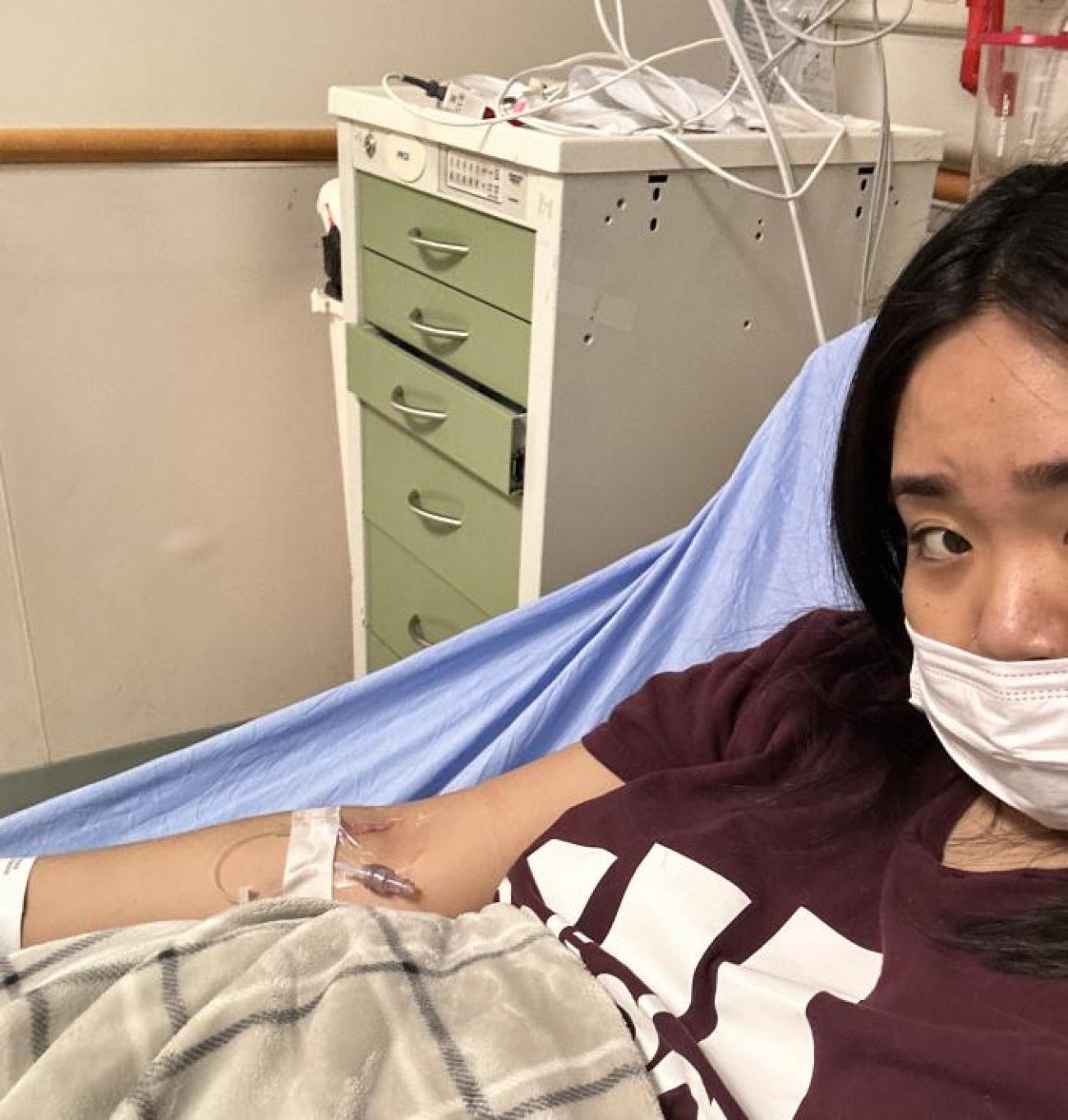
She was a sophomore in high school. Before she could try out for Cheer squad, she had to have a physical.
The routine Complete Blood Count revealed a problem.
Xinyi was then referred to a pediatric hematologist hematologist: (hee-muh-TOL-uh-jist) A doctor who specializes in treating blood diseases and disorders of blood producing organs. . At the same time, she continued with her rigorous high school schedule, even though she’d been prohibited from Cheer. She didn’t really understand that the potential diagnosis could be extreme---leukemia or Aplastic Anemia Aplastic Anemia: (ay-PLASS-tik uh-NEE_mee-uh) A rare and serious condition in which the bone marrow fails to make enough blood cells - red blood cells, white blood cells, and platelets. The term aplastic is a Greek word meaning not to form. Anemia is a condition that happens when red blood cell count is low. Most… ---until the bone marrow biopsy bone marrow biopsy: A medical procedure to remove a small piece of solid bone marrow using a needle that goes into the marrow of the hip bone. The solid bone marrow is examined for cell abnormalities, the number of different cells and checked for scarring of the bone marrow. .
The only child of loving parents, Xinyi had never had any health problems. She was very close to her family. Although she and her family were given the diagnosis of moderate Aplastic Anemia at the same time, she worried most about their reactions.
Because her condition seemed stable, her specialist did not accelerate treatment. For a long time, the “watch and wait” approach seemed best, so Xinyi had complete blood counts regularly. Although she couldn’t play sports because the potential for bleeding was too high, she enjoyed high school, graduated, and began her freshman year at university normally.
Her junior year, things began to change. She was in and out of the hospital, getting infections because her white blood cell white blood cell: Cells in the body that fight disease and infection by attacking and killing germs. There are several types of white blood cells including neutrophils, eosinophils, basophils, lymphocytes and monocytes. Each type of cell fights a different kind of germ. Also called WBC, leukocyte. counts were so low. Slowly, her lab work showed a slow decline in blood counts. Looking back now, she can see that increasing fatigue was beginning to take its toll even then. For example, in her junior year, she found herself out of breath walking from her car to the classroom building, a distance of only 30 feet. Later, she paid attention to another symptom, when a cold sent her to the Emergency Department. She started getting sick frequently, forcing more trips to the Emergency Department with fevers and infections.
Because the constant fatigue and frequent CBC tests along with blood transfusions blood transfusions: A blood transfusion is a safe and common procedure. Most people who have a bone marrow failure disease like aplastic anemia, MDS or PNH will receive at least one blood transfusion. When you receive a blood transfusion, parts of blood from a donor are put into your bloodstream. This can help some… , her symptoms inhibited her ability to keep up with schoolwork. She paused school that autumn, late in the semester. She couldn’t go to class or even take Final Exams. This was devastating; she had planned a career in laboratory science/ pharmaceutical research.
Ultimately, she fainted at her parents’ house. This was when her parents dialed 911 for ambulance and emergency care. With very low red blood cell red blood cell: The most numerous type of blood cell in healthy people. Red blood cells contain hemoglobin, a protein that picks up oxygen in the lungs and brings it to cells in all parts of the body. Also called erythrocyte, RBC. count and platelet platelet: The smallest type of blood cell. Platelets help the blood to clot and stop bleeding. Also called a thrombocyte. count, treatment began.
Xinyi started ATG therapy, which included four days of infusions, followed by cyclosporin, and then promacta as well. After she came home, she still needed weekly transfusions. Determined, she returned to university in spite of both the symptoms and the transfusion schedule.
Finally, at about six months post-ATG, she began feeling better. Her body began responding, which has continued until now, just a few years later. She was frightened the entire time before she saw progress, wondering how her health was holding her back from regular activities and her plans for her future.
Xinyi was able to graduate on time because she had taken additional classes her first few semesters in college, giving her the flexibility to have a lighter course load when she needed it. She majored in biology, finding a wonderful job in a lab while she began Graduate School!
Today, Xinyi says that her illness drives her passion and her motivation to help others through research. She wants to understand the source of disease and to help others with this knowledge. Her next graduation date is coming this year, preparing to contribute to treating disease through research.
As her health continues to improve, Xinyi reflects on her disease journey. Her parents have been her anchor, yet her worries also focused on them when she was at her worst point. She remembers her parents crying when they called for the ambulance. She knows how upset and worried they were for her.
“Keep doing what make you happy,” recommends Xinyi for other patients. She says it’s normal to have pessimistic thoughts and to feel hopeless but talk with people in your support system. It’s hard, she says; “They don’t understand what I had to go through,” she says. “Why is this happening to me when my friends are out in the world, having fun?” But it’s OK, she says, when patients feel this way. “It will be worth it when you put your health first.”